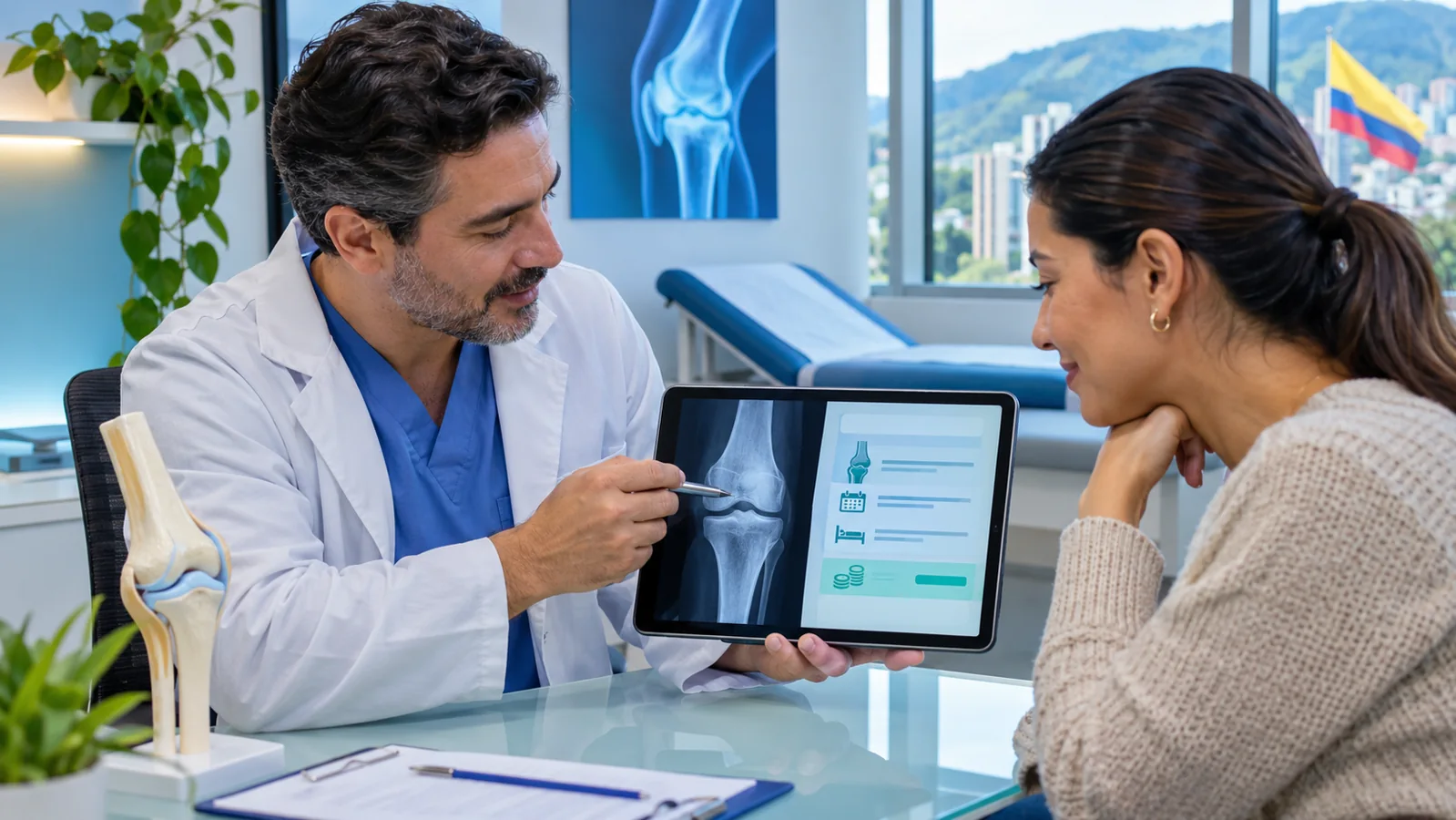
A virtual orthopedic consultation can be a useful first step when you are considering knee surgery in another city or country. It can help a specialist understand your history, review available imaging, explain which questions still need answers, and decide whether a later in-person examination is appropriate. It cannot replace every part of a physical examination. The goal is not to collect an instant surgical recommendation; it is to make a distant consultation informative enough that you know what to do next.
Patients often spend much of a first video call searching for a scan, trying to remember a medication, or describing a symptom without a timeline. A few hours of preparation can change that experience. You can preserve privacy, reduce repeat questions, and ask the provider for a reasoned response rather than a generic procedure price.
Decide what you want the call to answer
Write down your main decision in one sentence. Perhaps you want to know whether your current knee symptoms warrant another examination, whether a past ACL reconstruction should be reviewed by a revision specialist, or which records are required for a potential knee replacement estimate. State the question without choosing the treatment in advance.
It helps to separate three kinds of answers:
- Clinical evaluation: what your history and images may suggest, and what an examination or additional testing must establish.
- Logistics: whether the practice offers remote record review, which language it uses, and how follow-up works.
- Financial information: what is included in the consultation fee and what an individualized written treatment estimate may require.
A responsible clinician may decline to make a definitive decision remotely. That is a useful signal about the limits of the available information, not a failed appointment.
Build a one-page timeline of your knee problem
Start with the first meaningful symptoms or injury. Include the approximate date, which knee is involved, what happened, any swelling or instability, and how symptoms changed. Record the treatments you have tried, such as physical therapy, medication, injections, bracing, or prior operations, and the response to each. Note your ordinary activity level and the specific tasks that now cause trouble: stairs, walking distances, sleep, work, or sport.
For each prior operation, write the procedure date and facility if known, and whether a discharge summary or operative report is available. A statement like “arthroscopy in 2021” is less useful than the operative record describing what was done. You do not need to interpret that record yourself.
Give the clinician your current medication list, allergies, relevant medical conditions, and any concerns about anesthesia or clotting. Share the information through the clinic’s approved secure intake channel rather than an unsecured public form or social-media message. Ask which items are essential before sending sensitive details.
Imaging: original files and reports serve different purposes
A radiology report is the written description of an examination. The images are the actual study, often stored in a medical imaging format called DICOM. An orthopedic specialist may want both. A screenshot of an MRI report or a photograph of an X-ray viewed on a screen can be useful for orientation, but it may not provide the image quality or views necessary for clinical review.
Ask the clinic exactly what it accepts: a secure upload portal, an imaging-sharing link, or a physical disc. Confirm maximum file sizes, whether compressed folders are accepted, and who verifies that files arrived. Keep your own copies. The American Academy of Orthopaedic Surgeons advises patients attending an outside orthopedic appointment to arrange transfer of both medical and imaging records and not assume they will arrive automatically.
Label files sensibly without altering the images: for example, “right-knee-MRI-2026-08-report.pdf” and “right-knee-MRI-2026-08-DICOM.zip.” Use the actual study date and laterality. If a scan is old, mention that honestly; the specialist can determine whether new images would be useful.
Ask which views or examinations are still needed
Different clinical questions require different evidence. A surgeon evaluating a possible knee replacement may request particular weight-bearing radiographs, while a ligament or meniscus question may call for examination findings and potentially other imaging. Do not order scans independently just because an online checklist recommends them. Ask what question the proposed test would answer and whether it can be performed locally.
The physician may also need to assess range of motion, alignment, stability, gait, muscle strength, and symptoms that cannot be evaluated reliably on video. If they suggest an in-person visit, ask what can be accomplished in that appointment, how long it may take to receive an interpretation, and whether an operation would require a separate evaluation later.
Prepare questions that produce a useful explanation
A good remote consultation should leave you with an understandable next step. Consider asking:
- What possible explanations for my symptoms are worth evaluating, and what information is missing?
- Which nonoperative choices should be considered or revisited?
- What findings would support surgery, and what findings would argue against it?
- Is my case routine for your practice, or would a subspecialist be more appropriate?
- Which scans, physical findings, or laboratory information are needed before an estimate can be individualized?
- What are the material risks, alternatives, and likely rehabilitation demands if treatment is recommended?
- Can you provide a written summary of the consultation and a clear list of next steps?
Use your own priorities. For someone whose job requires standing, return-to-work questions may matter more than athletic performance. For an older traveler, rehabilitation support and medical comorbidities may be central. A one-size-fits-all answer should not displace your actual circumstances.
Know what a video consultation can and cannot establish
An online consultation can clarify records and options, but it does not automatically establish fitness for anesthesia or travel. It does not prove that surgery is indicated, promise a particular implant or technique, or guarantee recovery by a particular date. A reliable practice will explain what remains provisional and what must happen before booking a procedure.
Be wary of pressure to pay a large nonrefundable deposit during the first conversation or claims that every knee problem requires the same operation. Request the provider’s professional credentials, facility information, and a written treatment proposal. Compare the proposal with another qualified opinion when the decision is consequential.
If you experience sudden severe symptoms, fever with a hot swollen joint, inability to bear weight after injury, or other urgent changes, seek timely in-person medical care rather than waiting for an elective remote appointment.
Clarify fees before the call
Ask whether you are paying for a clinician-led evaluation, an administrative intake, or both. Find out whether the fee covers imaging review, a written note, questions after the consultation, translation, and any credit toward future treatment. Also clarify the cancellation policy if records are missing or the provider cannot review the case.
A low consultation fee can be reasonable, but a free conversation that never reaches a licensed clinician is not equivalent to an orthopedic evaluation. Record the professional’s name and credentials, and ask which jurisdiction governs the consultation. When multiple specialists are involved, determine who will issue the final recommendation.
Coordinate across time zones and languages
Confirm the time zone in writing and test the video application before the session. If you need an English-speaking clinician or qualified medical interpreter, ask whether that person will participate live. Do not rely on a relative to translate complicated consent or risk discussions. For important decisions, request a written summary in a language you can understand.
Bring another adult to the video call if you want support, but ask the clinic about privacy, recording, and consent. You may need to authorize a companion to receive personal medical information. Never assume that an online appointment can be recorded without permission.
Use a simple record packet
A compact packet often works better than dozens of unlabeled messages:
| Item | Useful detail | Who should interpret it |
|---|---|---|
| One-page timeline | Symptoms, injury, treatments, goals | Treating clinician |
| Medication list | Current doses and allergies | Clinician or pharmacist |
| Imaging reports | Study date, knee, findings as reported | Orthopedic specialist |
| Original imaging | DICOM files or approved imaging link | Qualified reviewer |
| Operative notes | Prior procedures, implants, complications | Orthopedic specialist |
| Your questions | Daily-life goals, costs, travel constraints | Clinic team |
Ask the clinic to confirm receipt before the meeting. Send nothing beyond what is appropriate for the evaluation, and keep a record of where your information was uploaded.
Request a specific written next step
At the end of the call, ask for a brief written plan. It should identify what information was actually reviewed, any unresolved questions, whether further examination is necessary, and the reasonable next step. If a treatment estimate is issued, request an itemized version showing surgeon, facility, anesthesia, implant or supplies as applicable, rehabilitation, follow-up, exclusions, and policies for complications or changes in the plan.
For international treatment, ask who coordinates local postoperative care and when travel can safely resume. The CDC notes that flying in the postoperative period can introduce additional risks, including blood clots. Individual clearance must come from the treating medical team; do not set your flight date from a generic internet timetable.
A sample message to the clinic
Hello, I am seeking an orthopedic opinion about my [left/right] knee. I have attached a short symptom timeline and reports from [dates]. I can share the original imaging securely if needed. Do you offer an English-language virtual consultation with an orthopedic specialist? Please confirm the review fee, the files required in advance, whether I will receive a written summary, and whether an in-person examination is likely to be necessary before any treatment estimate.
A good consultation is not the fastest call. It is the one that tells you which decisions are supported by evidence, which remain uncertain, and how to proceed without committing to surgery prematurely.
Next step: Use KneeQuote to request help organizing a knee treatment inquiry and comparing provider replies. A referral or quote request does not replace medical evaluation, and your choice of clinician remains yours.
Reference material for editorial verification
- American Academy of Orthopaedic Surgeons, Your Visit With an Ortho: https://www.orthoinfo.org/treatment/your-visit-with-an-orthopaedic-surgeon
- CDC Yellow Book, Medical Tourism: https://www.cdc.gov/yellow-book/hcp/health-care-abroad/medical-tourism.html
General educational information only. The treating clinical team must determine suitability, risks and follow-up. No treatment outcome is guaranteed.